PoulTech – Digital Poultry Farm Management Tools

This is an itch that we have been working on for a while, to leverage our over 12 years experience in raising commercial layers for eggs, and 5 years breeding local chicken for customers, into a set of easy of use digital tools for farmers.

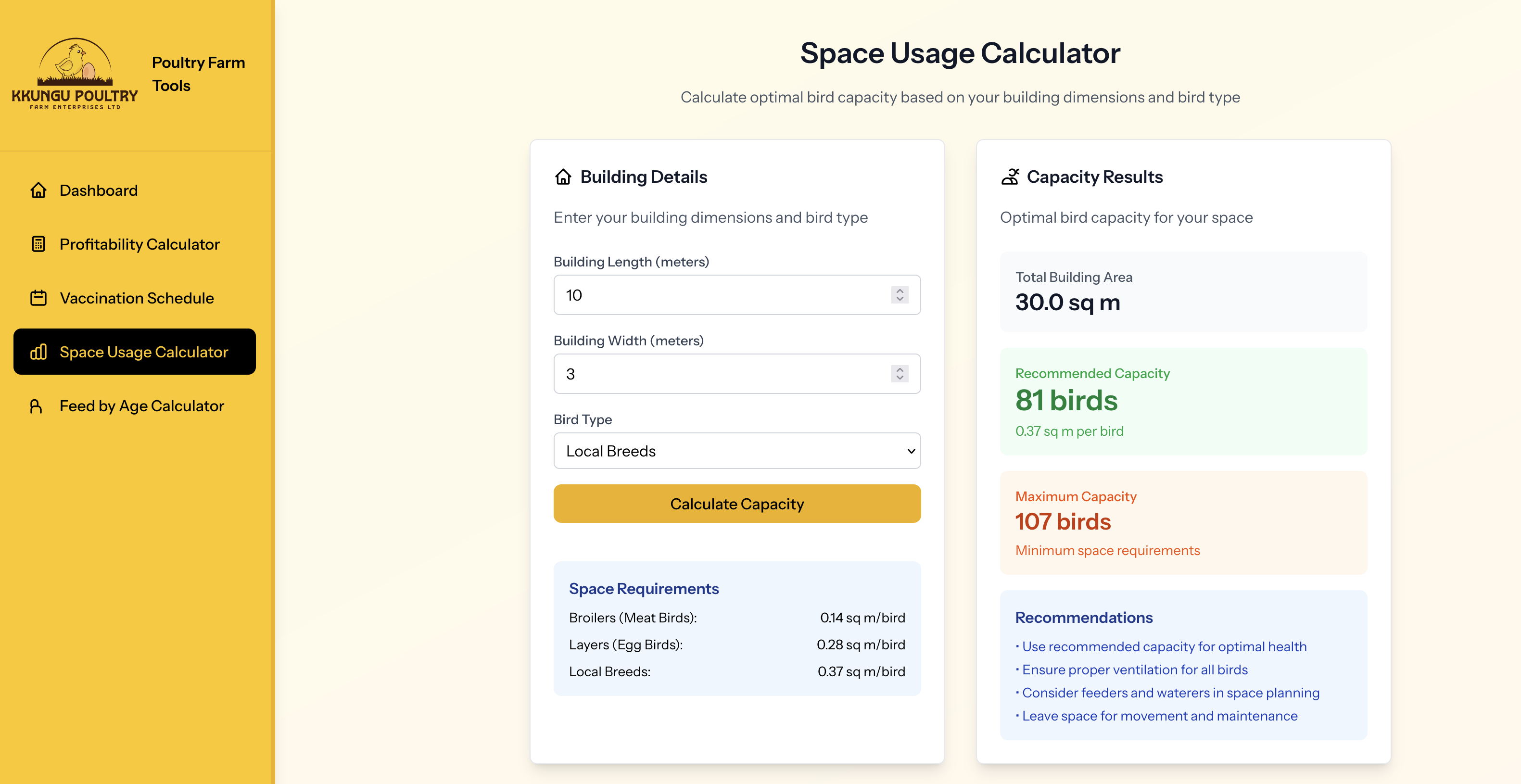
The tools added in this first set at https://app.kungu.farm/:

  1. Feed to Egg Profitability Calculator – computation of profits from layers
  2. Vaccination Schedule – schedule for layer vaccinations
  3. Space Usage Calculator – how many birds can you fit in a space that you have

More features to be added based on your feedback

How do I safely add local chicken from un-trusted sources to my home farm flock

This is a common occurance, where you could be gifted some chicken or buy some along your travels, that you want to integrate with your flock at home.

Our recommendation is not to add the new birds directly to your flock, as they could be disease carriers thus infect your existing birds, and in the worst case you could lose all of them. This has happened to other farmers

The approach we suggest you use is to isolate the birds and put them on a treatment regimen to ensure “most” disease is cleared before adding to your flock

DayActionNotes
1Antibiotic treatment for 5 daysCommmon is Tetracycline 10%, this will clear any infections that the birds have carried
7DewormWorms are easily transmitted within the litter this is the next step
9Newcastle + Infectious Bronchitis VaccinationThe two most common and deadly infections, this is done after the antibiotics and deworming
11Vitamin for 3 daysGiven all the medications this helps
37Deworming30 days from the last deworming, and use a different dewormer to ensure all the different types of worms are removed
39Newcastle + Infectious Bronchitis vaccination
Table 1: Isolation and treatment of foreign birds before integration in an existing flock

What approach have you used for your flocks?

Local Poultry Management Guide

As part of our path to improve local knowledge for raising and managing indeginous local birds, we have started working on a guide based on our experiences that can be used as a starting point for new and existing farmers

This guide will be evolved with feedback and inputs from farmers so please do share all the experiences that you have to help make it more solid

Send feedback to kungufarm@gmail.com

https://guide.kungu.farm/

Poultry Drugs and Medication

Can you offer technical advice on the use of those drugs in poultry? A question that came into my Inbox a couple of days ago

The answer below was given by a user “Chicken Doctor Himself” in a Poultry Whatsapp group

Ascalex is a dewormer composed of piperazine citrate. It is always used on evidence of worms or following the periodic routine of 30days for highly exposed chicken or 60 to 90 days in non exposed ones. Follow vets guidance and always do not follow it with a dewormer in the same class for better results attacking a different type of parasite keeping other factors costant .

Amilyte is a powdered in-water supplement with vitamins, amino acids and electrolytes all in one pack. It helps manage any kinds of stress such as treatment, after vaccinations, deworming, debeaking, change of feed etc

Doxin is a mixed antibiotic composed of doxycycline and tyrosin used in treatment of respiratory diseases but should be used on vets prescription. Remember flu is not a disease but a symptom so never rush to treat it.

Glucovit is composed of mild vitamin concentrations and glucose majorly used in early stages of birds growth or when energy levels of the birds are dowm due to different reasons .

Q and A: Newcastle Vaccines – Thermal Stable or Cold Version

Question: I have been using the “cold” Newcastle vaccine for my birds, however I am thinking of moving to the thermal stable version. Being paranoid knowing that it is important to stay consistent for a flock – does it make sense for me to move at this time to the thermal stable version

Answer by Dr. David Omoding of Quality Chemicals (U) Ltd

Your fears and apprehension are understandable. However, be assured that moving to the thermal stable version would be the right move for the reasons below:

  1. Vaccine failure is a major issue for any “cold” (thermolabile) vaccine from point of manufacture, thru transit, to storage at the pharmacy premises, transportation to your premises etc. Wipe that uncertainty away by using a thermostable vaccine.
  2. The Thermostable strain is called I2 and it offers quicker, stronger, longer lasting immunity to poultry as compared to the cold La Sota, Clone, R2 strains. It might be bit more expensive but surely worth every penny. More can be found from http://www.fao.org/docrep/005/ac802e/ac802e04.htm.

In extensive systems (free range), one application is sufficient for the life of the bird including local birds while In intensive systems we advise one application every 3 months.

Q and A: Management of Newcastle & Viral Diseases

Question: A friend’s birds started laying and have reached 50%. She was advised not to vaccinate Newcastle till they peak. Now she has noticed 2 that developed twisted necks. What should she do?

Dr. David Omoding – Quality Chemicals: The long-term health of the birds cannot be compromised for production performance. If vaccination is due, it should be done regardless of production level

Dr. Sewagudde Samuel – Genesis East Africa Ltd: Some birds can react post vaccination, 10- 14 days later, and show signs of disease, but with use of antibiotics, you can help them fend off the associated infections

Background to Answers:
Viral diseases like NewCastle and Gumboro normally destroy or weaken the immune system, just like the Humman Immuno-Deficency Virus (HIV) for humans. This then allows bacteria to take advantage of the reduced of immunity to cause further havoc through secondary intestinal, respiratory and other infections which further reduce productivity and potentially cause mortality.

Therefore treat such situations with antibiotics and vitamins to kill the bacterial and boast the immunity. Common antibiotics trade names include Keprocoeryl, Tetracycline 20% or 25%, Enrosol, etc. The vitamins combos include Amino vital, Aminovit, Cholivit, Vitalyte, etc

Quality Chemicals Uganda Limited also has vaccines of all kinds for poultry and larger animals. The latest on their list is the thermal stable Newcastle vaccine which does not need to be maintained under cold conditions, and soon the injectable Newcastle given prior to laying reducing the need for continous boosting during laying.

Vaccination Schedule up to Week 12

Well today the chicks make 3 weeks, and we are going ahead with our regular vaccination schedule. I decided to share our schedule for others to learn and comment on. The vaccination is done every Thursday (Day 0) so every week mentioned below is based on the day the chicks were delivered 

  • Day 7 (Week 1) – IB via drop in eye
  • Day 10 – Mareks via injection under the wing 
  • Week 2 – Newcastle via drop in eye
  • Week 3 – Gumboro via drop in eye
  • Week 4 – Newcastle
  • Week 5 – Gumboro
  • Week 6 – Newcastle
  • Week 7 – Gumboro
  • Week 8 – Fowl Pox  
  • Week 9 – Fowl Typhoid 
  • Week 10 – Newcastle
  • Week 11 – Gumboro 
  • Week 12 – Debeaking 

After Week 12, I will update the schedule accordingly when the time comes  

Vaccination – Preparations and Setup

Yes, we had a tough first week, but we lived through it although the losses were up to 10% of what we received, this is pretty high, but being inexperienced we can put it to the costs of learning on the job.

The vaccination schedule is every week for the next 12 weeks, with Newcastle and Gumoboro being alternated, I will post our vaccination schedule once I get round to typing it up. 

Here I explain how we setup for vaccination for those who like me are learning on the job. Pre-vaccination checklist:

  1. No vitamins or other medication in the water for the day before
  2. No water provided to the chicks for 2 hours before the vaccination, apparently to assist in ingestion especially the ocular ones which are administered one drop in each eye

First we created two separate areas within the brooder using plywood 

Brooder with separator for chicks vaccinated and those that are not

The vaccination operation was manned by 3 people – two vaccinating and one picking up the chicks and passing them to the other two. The reason for this is efficiency (due to split roles), but also to ensure that the operation is done quickly so that the vaccine remains chilled.

vaccination in progress

And once the vaccination is done the plywood is removed and the chicks are back to using the whole room as their playground. Also there is countinous monitoring for any changes in the behavior and feeding habits 

brooder after vaccination - chicks roaming around freely

Want to learn more about vaccination procedures from experts you can go to http://www.poultryhub.org/health/health-management/vaccination/