Get me outta here!

A Ugandan Farmer

Adventures of a farmer in Uganda who is learning on the job but is determined to succeed against all odds

Menu

Skip to content
  • Home
  • Terms and Conditions

Author Archives

ssmusokehttp://ssmusoke.comI am a technologist at heart working with software development teams deliver custom software for clients. In previous roles in other organizations, I have assisted customers identify user and business needs, defined technical specifications to meet those needs, evaluated vendor capability and supervised implementation of complex IT systems. I am passionate about growing the technology community in Uganda and on the continent. I believe in the mantra “Coded in Africa, for Africans by Africans”. My emphasis during this journey is to ensure that women are equal participants in the African technology revolution.
ssmusoke's avatar

PoulTech – Digital Poultry Farm Management Tools

July 14, 2025 by ssmusoke

This is an itch that we have been working on for a while, to leverage our over 12 years experience in raising commercial layers for eggs, and 5 years breeding local chicken for customers, into a set of easy of use digital tools for farmers.

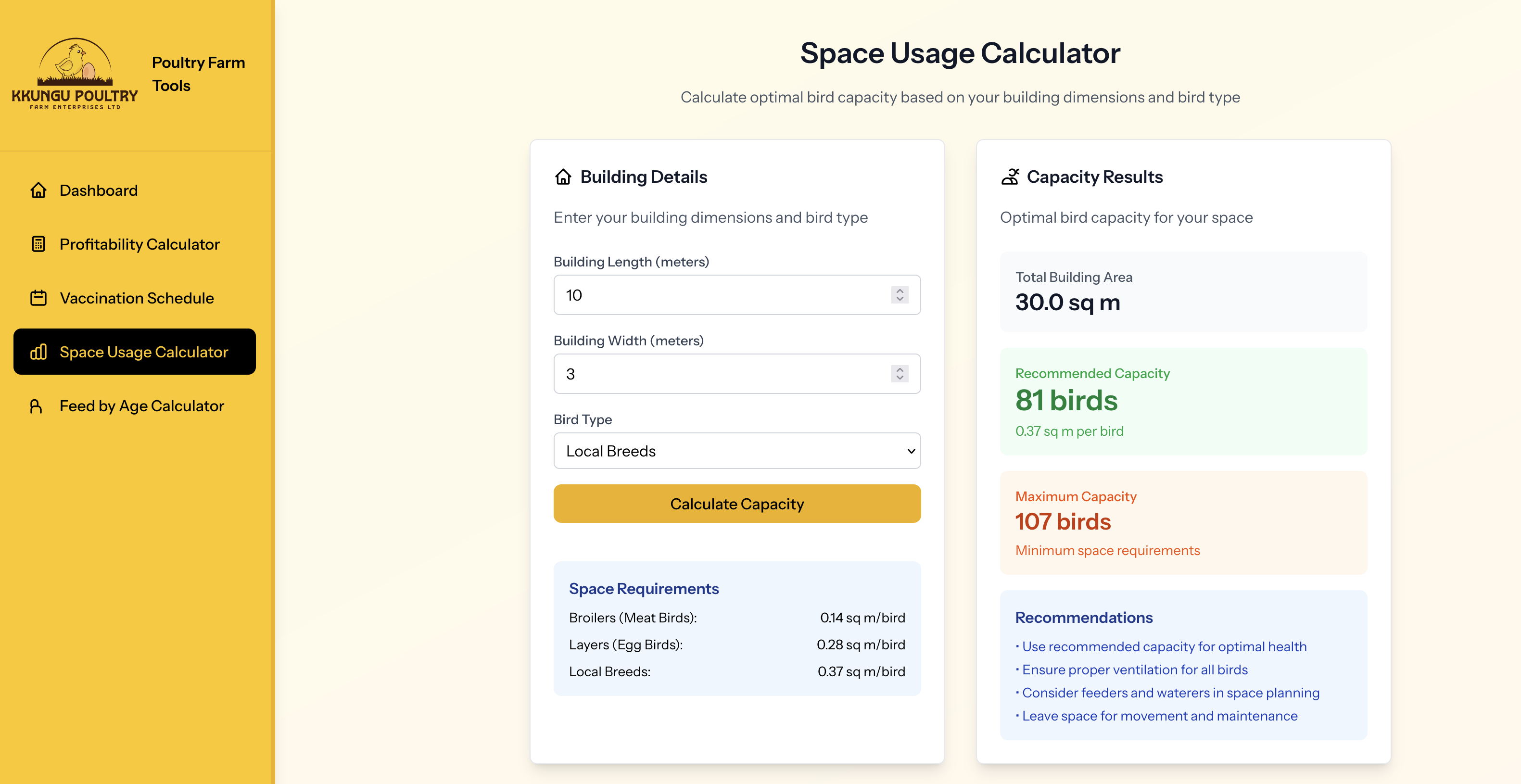
The tools added in this first set at https://app.kungu.farm/:

  1. Feed to Egg Profitability Calculator – computation of profits from layers
  2. Vaccination Schedule – schedule for layer vaccinations
  3. Space Usage Calculator – how many birds can you fit in a space that you have

More features to be added based on your feedback

Poultry Farm Management Tools
Feed to Engg Profitability Calculator
Space Usage Calculator
Vaccination Schedule Calculator

Share this:

  • Click to share on X (Opens in new window) X
  • Click to share on Facebook (Opens in new window) Facebook
Like Loading...
poultry tech digital toolsfarm recordspoultryvaccination Leave a comment
Disinfeciting a poultry house before receiving birds

Disinfection and preparation of a poultry house before receiving new flocks

June 17, 2024 by ssmusoke

If a chicken house has been used before and you have time, you could try the following approach we use

1.⁠ ⁠Jik in water – 250ml of Jik in 20l of water, spray the whole house, laying boxes and walls until drenched, then leave to dry. This may need 3 to 5 days depending on the weather
2.⁠ ⁠⁠Kisula (rock salt) – 1kg of salt in 10l of water, especially for the walls, corners, inside, under and behind laying boxes – then leave to dry which may need 2 to 3 days
3.⁠ ⁠⁠Use some of the commercial non-toxic disinfectants on the market

That 3-phase cycle helps us get clean out the houses and slow infection builds

When the birds are in we also disinfect spraying with a non-toxic chemical once every 2 weeks to prevent disease build-up in addition to other litter management techniques

Disinfecting of a poultry house before receiving new birds

Share this:

  • Click to share on X (Opens in new window) X
  • Click to share on Facebook (Opens in new window) Facebook
Like Loading...
health livestock poultry brooderdisease preventionpoultry Leave a comment

Building a Chicken House – Experience

June 5, 2024 by ssmusoke

This is to share our experience building out a new local chicken house as well as the ideas that we considered, as documented on X at https://x.com/kungufarm/status/1352324851948781572?s=20

There was space on a wall, which we considered as the space for the home chickens. The design decisions we made are as follows:
1. It would be 1 iron sheet wide, 9 feet long, giving a width of 8 feet to cater for the slope.
2. The length would be 35 feet, with 3 rooms each 10 feet wide, and a store of 5 feet to store food, and equipment and maybe act as a sickbay.

Boundary Wall space before the building came up
The starting point
Setting the foundation for the chicken house
Foundation has been dug

Once the foundation was completed then we roofed it to ensure that it met the planned size without requiring changes

The walls are low, usually 4 to 5 bricks high, however we increased this especially for handling water sprays from the roof, and being on a slope they are of different heights

Add the chicken mesh, as you may notice there are 3 rooms each 10 feet wide, with its own door to enable separation of different birds as may be needed. The last room is the store for storage. Laying birds need a lot of aeration for proper growth so chicken mesh is used in the spaced.

When a room is needed as a brooder we cover the windows with plastic to maintain the heat within the room

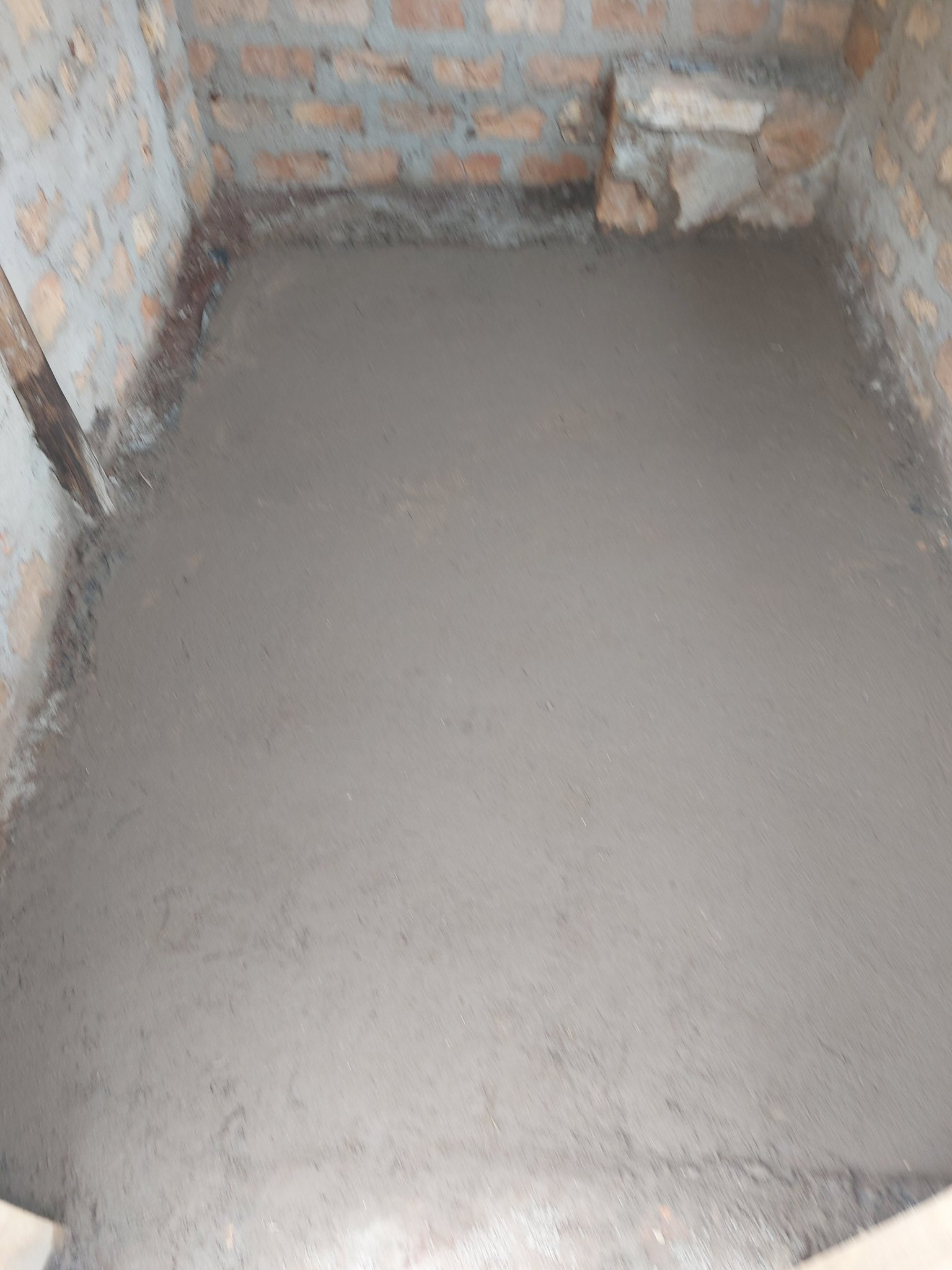
The floors are concrete to ensure the birds do not dig to the soil underneath transmitting diseases

Store room floor
Store room flooring
A view of the chicken house floor

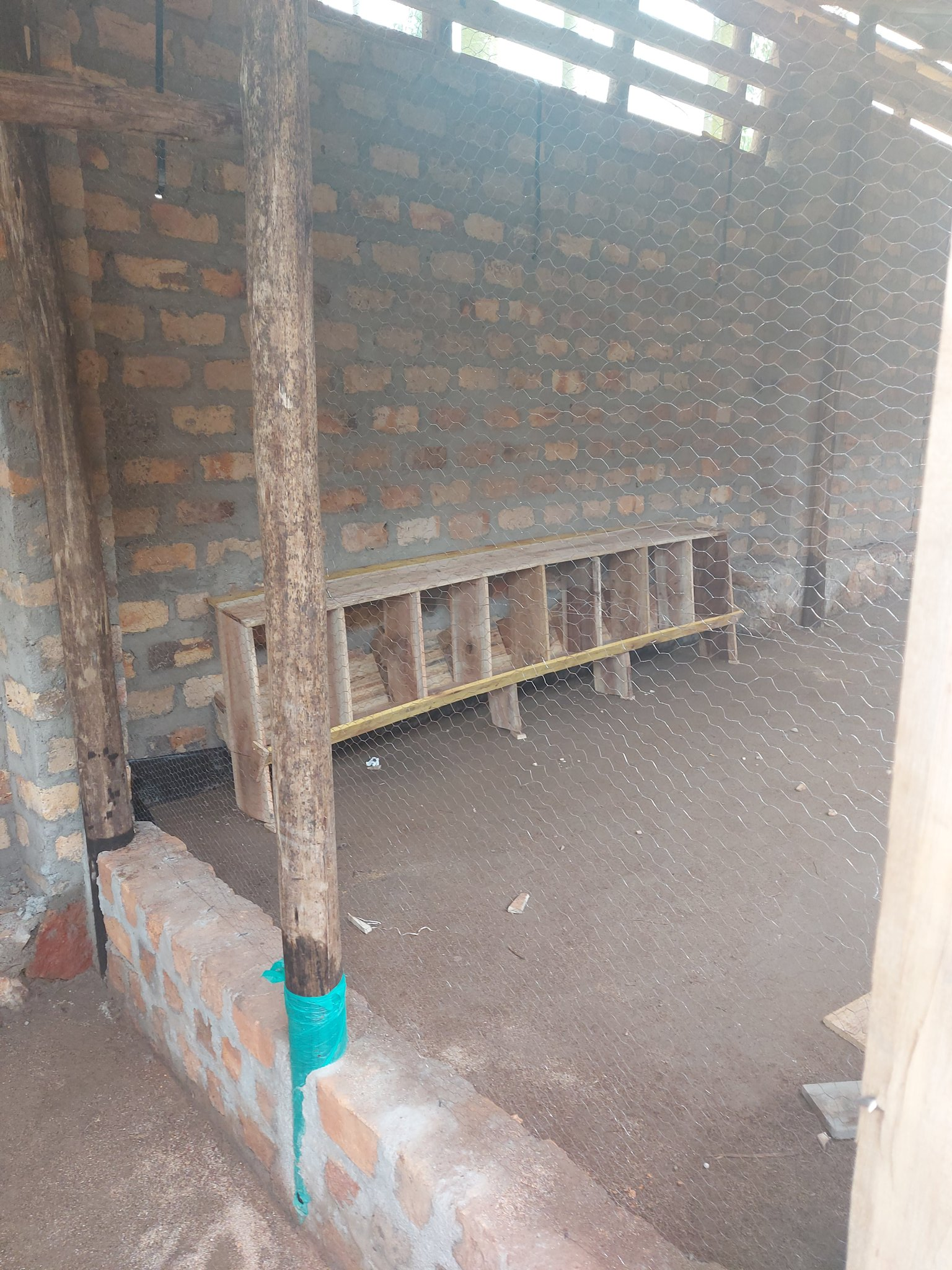
The laying boxes are next where we expect the birds to drop their eggs

Laying boxes in Room 1
First room with hatching boxes
Laying Box in Room 2
2nd room with hatching boxes
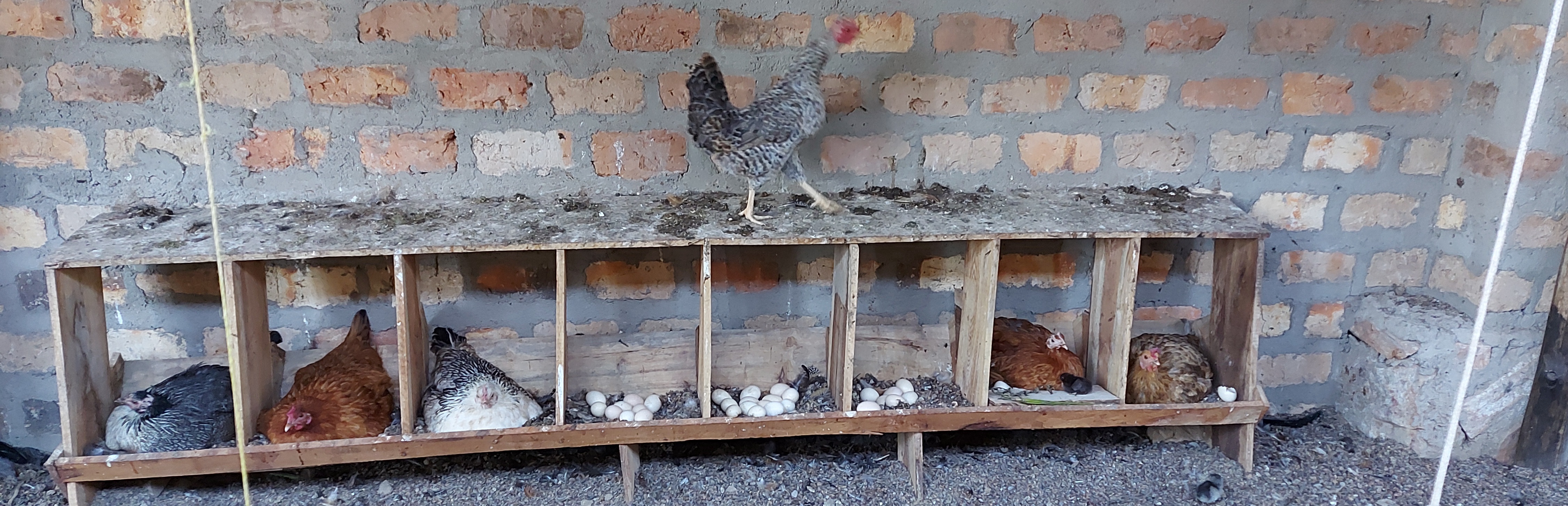
Hatching boxes in use
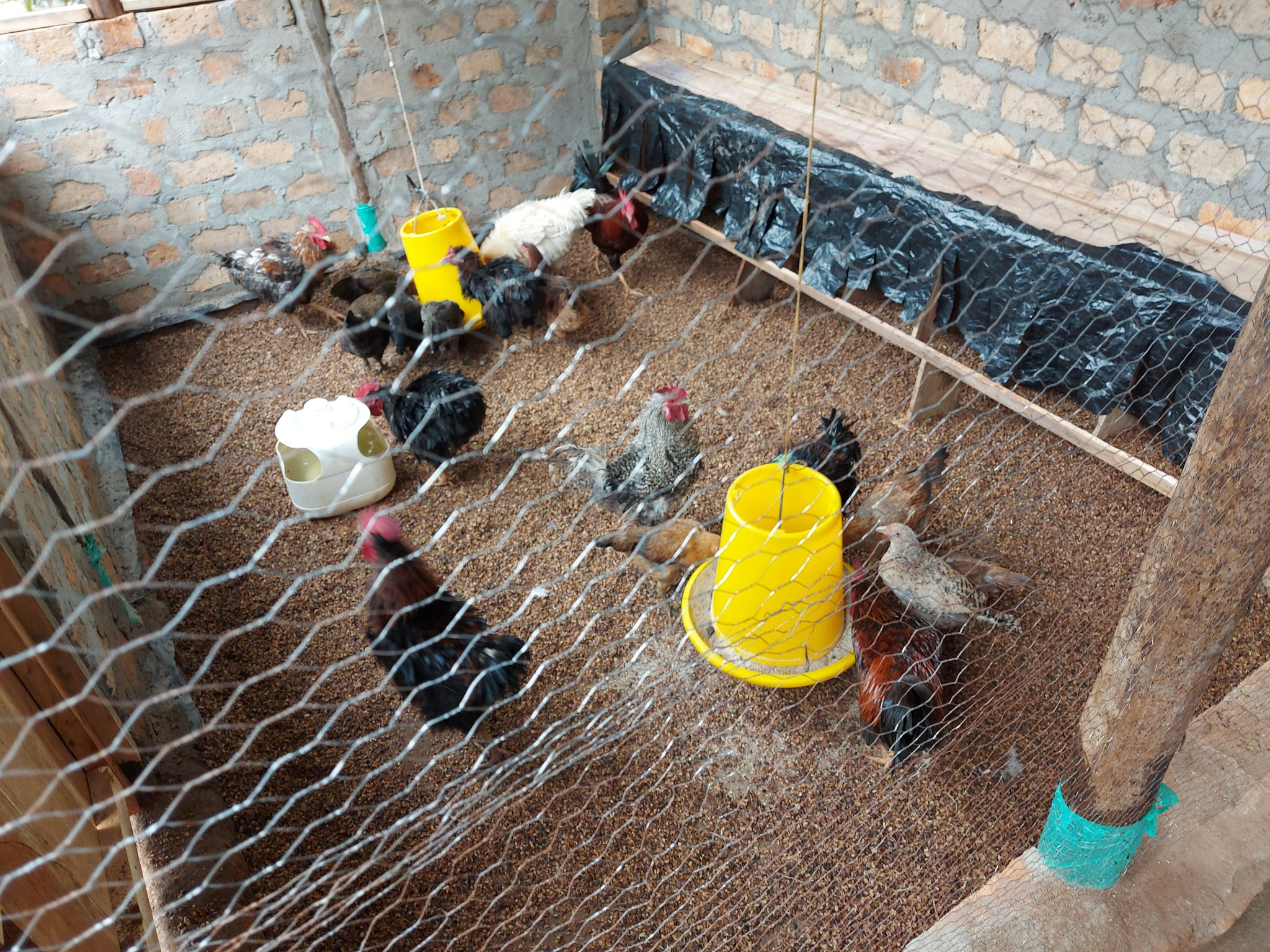
Coffee husk litter added to the room
Chickens added to the room
A couple of weeks later

Share this:

  • Click to share on X (Opens in new window) X
  • Click to share on Facebook (Opens in new window) Facebook
Like Loading...
livestock poultry housingpoultry Leave a comment

2024 – The year Local Chicken comes mainstream

December 31, 2023 by ssmusoke

We have been key advocates for local chicken over the years, and in 2022 we made a pivot from commercial layers, into breeding and raising local birds, based on parent stock from a reputable breeder.

Strategy for Maximizing Outputs

The key to maximizing the outputs for local chicken is based on:

  • Improved nutrition – rather than feed the birds on leftovers, plain maize bran leverage concentrate based feeds like commercial hybrids (while managing costs)
  • Proactive care and treatment – vaccination (following the same schedules as commercial hybrids), regular deworming and vitamin boosts
  • Management – clean and airy rooms, dry litter, clean water and feeding utensils, birds per square meter, number of birds per drinker and feeder
  • Dark laying boxes for hens for eggs
  • Debeaking of hens so that they do not eat their eggs, additional trimming of claws for cocks so that they do not tear the backs of the hens for breeding stock

Market Opportunity

This is always a key question to adoption, and there are two paths:

  1. Home Farming – this approach is for anywhere between 10 to 50 birds, a great place for those who are new to the poultry business. The focus of this approach is:
    • Improve household nutrition – when the hens start laying, chicken for meals (cocks are best for this), as a starting point for households
    • Increase household incomes – once the family has sufficient nutrition, the extra eggs can be sold off, the hens/cocks can be sold off not just for meat but for breeding too
    • Provide training for children home – to understand how to raise chicken, responsibilities, maintaining clean living spaces for them, repairs and creativity in solving common problems
  2. Commerical Purposes – the dual purpose birds are competitive with commercial hybrids if you target different aspects
    • Cocks/hens do not grow as heavy as kuroilers but are preferred for traditional ceremonies, gifts, even slaughter during Eid and for discerning customers
    • Hens do not lay as much as commercial hybrids, only up to 75-85% depending on management, however their offlaying prices are almost 100% higher. Adding green to get yellow yolk eggs provides a premium over the numbers that hybrids produce making breaking even much easier for smaller numbers

Overall the market opportunity is with premium pricing for the birds, eggs and their meat, rather than going head to head with the hybrids broilers and layers, like the marketing books say “Change the rules of the game so that you can compete”

Where do I begin?

The most important question, depends on where you are, however our recommendation is to always start small to what you can manage and afford

  1. Home farming – 10 to 30 birds which helps balance the amount of investment and effort to the outputs
  2. Commerical farming – 50 to 100 birds, for a beginner, and more depending on your experience however targeting a specific market is very important to get clarity on the birds you will select to invest in

How can we help you get started?

We breed and sell all ages of birds, you can select the gender from 4 to 6 weeks when anatomical features become more prominet

  1. Day old chicks – the lowest cost starting point, best if you have experience, capacity and resources for brooding
  2. 4 week old birds – these are the sweet spot for many farmers, the birds are just out of the brooder, not needing additional heat in the evenings
  3. 8 week birds – after fowl typhoid vaccination
  4. 16 weeks – adult birds which are usually adversely affected by any environment changes, thus gives sufficient time for recovery before laying commences from 20 weeks

Resources

What do they look like?

Day old chicks at feeding time
Local chicken
A majestic local cock

Share this:

  • Click to share on X (Opens in new window) X
  • Click to share on Facebook (Opens in new window) Facebook
Like Loading...
poultry agribusinesschickenseggshome-farminglocal-chickenpoultry Leave a comment

How do I safely add local chicken from un-trusted sources to my home farm flock

October 25, 2023 by ssmusoke

This is a common occurance, where you could be gifted some chicken or buy some along your travels, that you want to integrate with your flock at home.

Our recommendation is not to add the new birds directly to your flock, as they could be disease carriers thus infect your existing birds, and in the worst case you could lose all of them. This has happened to other farmers

The approach we suggest you use is to isolate the birds and put them on a treatment regimen to ensure “most” disease is cleared before adding to your flock

DayActionNotes
1Antibiotic treatment for 5 daysCommmon is Tetracycline 10%, this will clear any infections that the birds have carried
7DewormWorms are easily transmitted within the litter this is the next step
9Newcastle + Infectious Bronchitis VaccinationThe two most common and deadly infections, this is done after the antibiotics and deworming
11Vitamin for 3 daysGiven all the medications this helps
37Deworming30 days from the last deworming, and use a different dewormer to ensure all the different types of worms are removed
39Newcastle + Infectious Bronchitis vaccination
Table 1: Isolation and treatment of foreign birds before integration in an existing flock

What approach have you used for your flocks?

Share this:

  • Click to share on X (Opens in new window) X
  • Click to share on Facebook (Opens in new window) Facebook
Like Loading...
poultry Q and A poultryvaccination Leave a comment

Local Poultry Management Guide

April 15, 2023 by ssmusoke

As part of our path to improve local knowledge for raising and managing indeginous local birds, we have started working on a guide based on our experiences that can be used as a starting point for new and existing farmers

This guide will be evolved with feedback and inputs from farmers so please do share all the experiences that you have to help make it more solid

Send feedback to kungufarm@gmail.com

https://guide.kungu.farm/

Share this:

  • Click to share on X (Opens in new window) X
  • Click to share on Facebook (Opens in new window) Facebook
Like Loading...
poultry day-old chicksfarm recordsknowledge sharingvaccination Leave a comment

Poultry Farm Records Keeping – Part II

March 20, 2023 by ssmusoke

This is a follow on from https://kungu.farm/2014/06/08/farm-record-management/ which goes into more detail into the details of records management that we have developed over the years

The image below illustrates a sample page for tracking daily information for one of our flocks

Daily Record Sheet for Poultry Farm Flock

The key pieces of data collected

  1. Feeding plan – when and how much drinking water & feed are provided
  2. Any mortalities during the day and root cause analysis
  3. What medication has been provied in the water or feed
  4. Egg production – these are picked from the hatching boxes every hour to reduce damage, egg eating and brooding (when the hens sit on the eggs), with a production percentage computed and tracked

A summary of this information is sent via SMS message to the Operations manager daily e.g.,

House A 17kgs, water 3jerricans, alive hens 229,B in good condition water 2jerricans, feed 10kgs, alive chicks 193

How do you keep records on your farm?

Share this:

  • Click to share on X (Opens in new window) X
  • Click to share on Facebook (Opens in new window) Facebook
Like Loading...
agribusiness poultry farm recordsproductivity Leave a comment

Poultry Drugs and Medication

November 9, 2022 by ssmusoke

Can you offer technical advice on the use of those drugs in poultry? A question that came into my Inbox a couple of days ago

The answer below was given by a user “Chicken Doctor Himself” in a Poultry Whatsapp group

Ascalex is a dewormer composed of piperazine citrate. It is always used on evidence of worms or following the periodic routine of 30days for highly exposed chicken or 60 to 90 days in non exposed ones. Follow vets guidance and always do not follow it with a dewormer in the same class for better results attacking a different type of parasite keeping other factors costant .

Amilyte is a powdered in-water supplement with vitamins, amino acids and electrolytes all in one pack. It helps manage any kinds of stress such as treatment, after vaccinations, deworming, debeaking, change of feed etc

Doxin is a mixed antibiotic composed of doxycycline and tyrosin used in treatment of respiratory diseases but should be used on vets prescription. Remember flu is not a disease but a symptom so never rush to treat it.

Glucovit is composed of mild vitamin concentrations and glucose majorly used in early stages of birds growth or when energy levels of the birds are dowm due to different reasons .

Share this:

  • Click to share on X (Opens in new window) X
  • Click to share on Facebook (Opens in new window) Facebook
Like Loading...
health poultry bacterial diseaseschicksknowledge sharingvaccination Leave a comment

Poultry Laying Box Design

June 24, 2021 by ssmusoke

A common challenge with poultry especially layers is the design of the design and use of laying boxes. I will be sharing the design of boxes that we have used and the reasons for the design choices, including enhancements we have made in newer iterations

The design considerations are:

  1. The slanting top about 45 degrees stops the birds from spending time at the top of the laying box, and soiling it (the last image below illustrates this adequately)
  2. The laying box has to be placed close to the wall so that the birds do not climb on the edge
  3. The laying boxes are 1 foot wide to fit a laying bird, or even two especially during peak laying times from 9am to 11am
  4. The laying boxes are also about 1.5′ high so that there is sufficient clearing for the birds and cleaning is a breeze
  5. The floor is slanted at a small angle so that the eggs roll to the wall – it should not be a large angle to break the eggs
  6. Coffee husk shavings can also be added on the floor to keep the eggs from cracking when laid, and to provide comfort in cases where the hens are allowed to incubate the eggs
  7. At the front is a wood barrier to protect birds inside from getting their behinds pecked by those on the ground (this is common as the birds turn to position themselves to lay) and protects the eggs from being eaten
  8. The height of the laying box is about 15cm (0.5′) so that a bird cannot fit below but the birds can get in easily
  • Frame – using kirundu
  • Each laying box is about a foot wide
  • Adding a bar at the front
  • Deployed in the house
  • Another completed version
  • Laying box in use but is soiled at the top because the slope allows birds to use the top section

Share this:

  • Click to share on X (Opens in new window) X
  • Click to share on Facebook (Opens in new window) Facebook
Like Loading...
poultry brooderchickspoultry Leave a comment

Surviving the COVID Lockdown – A Farmer’s Perspective

May 29, 2020 by ssmusoke

March 31, 2020 will forever be etched into our minds, as the President of Uganda announced a 14 day lockdown with no movement of private cars, only motorcyles, lorries and pickups allowed.

At first glance I can say that we were very fortuate, as our most senior staff at the farm had left the day before to see his wife through childbirth for their second child who was due April 9th, but came April 2nd. He would definitely have missed the birth and first days had he stayed a day longer.

This was the test of the processes and tools that we had put in place since we started this joruney in January 2013:

  1. Feed preparation
    • This is fully outsourced although we control the formulation process, and fully mixed, packed food is delivered to the farm in 100kg bags. We weigh on delivery and cross check with the order made. This proved to be the right call as the trust relation with the feed mixing provider meant we did not have to be present at all times, and transactions could be completed remotely.
    • During this process due to stockout of the 10% concentrate formulation we successfully moved to a 5% concentrate formulation
    • The feed is prepared once a week, which reduces the need for adding preservatives to keep it for longer, and provides an opportunity to make quick changes based on feedback from the birds – always measured by productivity
  2. Farm Records Management
    • On a daily basis we track the total feed and water consumption, production (number of trays per house) which provided remote visibility into how the farm was running
    • In addition we track finer details such how many eggs were picked per hour, how much feed and water is given in the morning and afternoon. This helps spot trends and changes in behavior based on weather and other factors
  3. Production and Sales Management
    • Previously we delivered to our customers which removed visitors from the farm, helping us manage biosecurity and good old security since no visitors are allowed to come in and eggs to leave. However with the lockdown this changed due to transport constraints
    • All deliveries were pre-paid before pickup as no credit was allowed, intially payments were made to the bank (via agent banking) however now this had to change to mobile money due to movement restrictions
    • Stock management – we agressively manage our stock having order levels at 120% of production, and carefully managing our customer deliveries to keep them happy. This was put to the test with a double punch of 3-week lockdown extension and start of Ramadhan, which pushed prices to below cost and at one time we had 800 trays (over 2 weeks of production)
    • Price management – we track and manage egg sales price based on the cost of feeds
  4. Farm Operations – we have regular activities at the farm to maintain the health of the birds which include
    • Monthly deworming followed by Newcastle vaccination
    • Scheduled pre-emptive veterinary service visits to check on the stool, and look for any signs of sickness as well as assess overall biosecurity controls. Additional visits would be triggered by changes in feed & water consumption plus productivity
    • Movement Sticker – we got this one through application to the Ministry of Works, as the farm is a registered legal entity that also files taxes with URA, so proof of need was not difficult to provide
    • The two staff who were at the farm during this period did a tremendous job earning themselve a 50% monthly salary bonus, for holding the fort.
    • The production manager had 2 daily checkin calls (or more)

The lockdown has now been eased with a partial re-opening started, which has pushed up demand and has provided a window for us to complete renovations and prepare for a new flock coming in on June 9, 2020.

What have been your lessons for running your farm operations during this lockdown? What will you change and improve for the future?

Share this:

  • Click to share on X (Opens in new window) X
  • Click to share on Facebook (Opens in new window) Facebook
Like Loading...
agribusiness business models poultry knowledge sharingproductivityrecords management Leave a comment

Post navigation

← Older posts

Get In Touch With Us

P. O. Box 8563 Kampala, Uganda
Email: kungufarm at gmail dot com

Recent Posts

  • PoulTech – Digital Poultry Farm Management Tools
  • Disinfection and preparation of a poultry house before receiving new flocks
  • Building a Chicken House – Experience
  • 2024 – The year Local Chicken comes mainstream
  • How do I safely add local chicken from un-trusted sources to my home farm flock

Enter your email address to follow this blog and receive notifications of new posts by email.

Join 54 other subscribers
Create a free website or blog at WordPress.com.
A Ugandan Farmer
Create a free website or blog at WordPress.com.
Privacy & Cookies: This site uses cookies. By continuing to use this website, you agree to their use.
To find out more, including how to control cookies, see here: Cookie Policy
  • Subscribe Subscribed
    • A Ugandan Farmer
    • Join 54 other subscribers
    • Already have a WordPress.com account? Log in now.
    • A Ugandan Farmer
    • Subscribe Subscribed
    • Sign up
    • Log in
    • Report this content
    • View site in Reader
    • Manage subscriptions
    • Collapse this bar
 

Loading Comments...
 

You must be logged in to post a comment.

    %d